
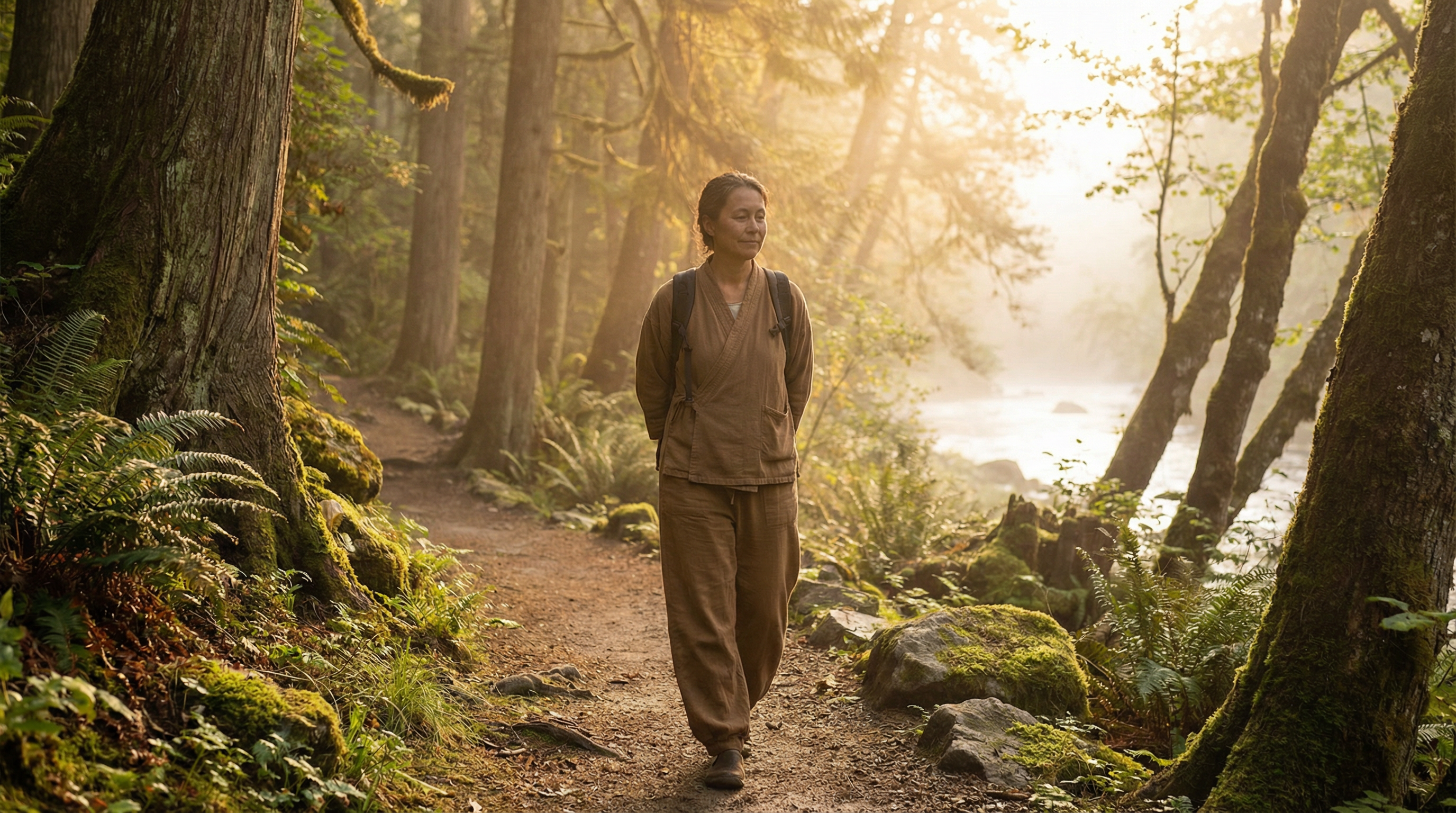
Meditation Does Not Have to Be Still
Many people struggle with seated meditation. Restlessness, distraction, or lack of time often get in the way.
Mindful walking offers an alternative that is both accessible and surprisingly effective.
Several studies over the last decade show that walking meditation can meaningfully reduce stress and support mindfulness, even for beginners.
The Research Behind Mindful Walking
One of the most cited clinical studies on mindful walking was conducted by Teut and colleagues and published in 2013.
The researchers investigated whether mindful walking could reduce psychological distress in adults who did not regularly meditate.
Link to the paper: https://pubmed.ncbi.nlm.nih.gov/23983786/
What the Study Found
Participants who practiced mindful walking showed:
- Reduced psychological distress
- Improved mood
- Increased present-moment awareness
Importantly, many participants reported that walking felt more natural than sitting meditation and easier to maintain over time.
Why Walking Supports Mindfulness
Walking naturally anchors attention through:
- Rhythmic movement
- Sensory feedback from the body
- A gentle but steady focus
This makes it easier to stay present without forcing concentration.
From a neuroscience perspective, movement engages attentional and sensory systems simultaneously, which can stabilize awareness.
How intuno Builds on This Insight
intuno uses walking as one of its core meditation contexts.
- Guidance adapts to pace and environment
- Attention cues align with natural movement rhythms
- Meditations fit into walks people already take
This lowers the activation energy of meditation and increases consistency.
Practical Takeaway
If sitting still feels hard, it is not a failure. Your nervous system may simply learn better in motion.