
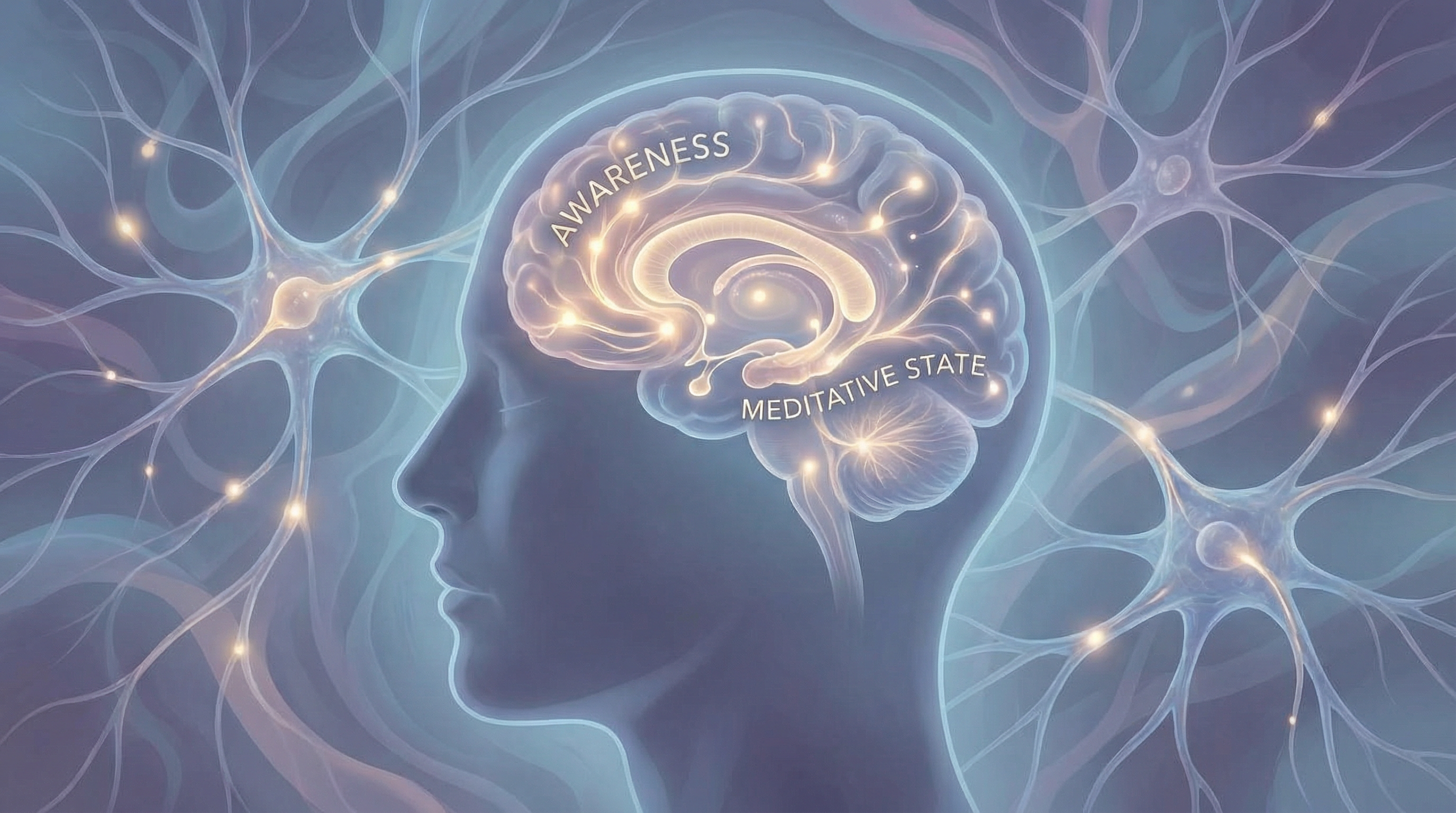
Mindfulness Is Not One Skill
Mindfulness is often described as paying attention to the present moment. Neuroscience tells a more nuanced story.
According to one of the most cited reviews in the field, mindfulness meditation trains multiple interacting brain systems that govern attention, emotion, and self-awareness.
This influential review was published in Nature Reviews Neuroscience by Yi-Yuan Tang, Britta Hölzel, and Michael Posner.
Link to the paper: https://www.nature.com/articles/nrn3916
The Three Core Systems Trained by Mindfulness
The authors describe three primary mechanisms through which mindfulness meditation works.
1. Attention Regulation
Meditation improves the ability to notice when attention drifts and to return it more efficiently. This is not about forcing concentration.
It is about recovering attention faster and with less effort.
2. Emotion Regulation
Mindfulness changes how emotions are processed.
Instead of suppressing feelings, practitioners develop greater emotional flexibility. Stressful experiences still occur, but recovery becomes faster and less reactive.
3. Self-Awareness
Meditation alters activity in brain networks involved in self-referential thinking and rumination.
Over time, thoughts are experienced more as events rather than as facts. This reduces over-identification with inner narratives.
Why This Paper Was So Influential
This review helped shift mindfulness away from vague descriptions and toward clear mechanisms.
It showed that mindfulness is a form of mental training, similar in principle to physical training, but applied to cognitive and emotional systems.
From Short-Term States to Long-Term Traits
The review also highlights an important pattern:
- Short and irregular practice mainly influences temporary states
- Integrated and repeated practice supports lasting trait change
This insight is crucial for designing meditation experiences that actually carry over into daily life.
How intuno Uses These Findings
intuno is built directly around these mechanisms:
- Attention regulation is trained during real activities, where focus is naturally challenged
- Emotion regulation is supported through meditations that adapt to how you feel in the moment
- Self-awareness is strengthened through gentle reflection connected to lived experience
Instead of practicing mindfulness in isolation, intuno trains these systems where they are actually needed.
Practical Takeaway
Mindfulness is not passive relaxation. It is an active training of attention, emotion, and awareness that works best when integrated into everyday life.